
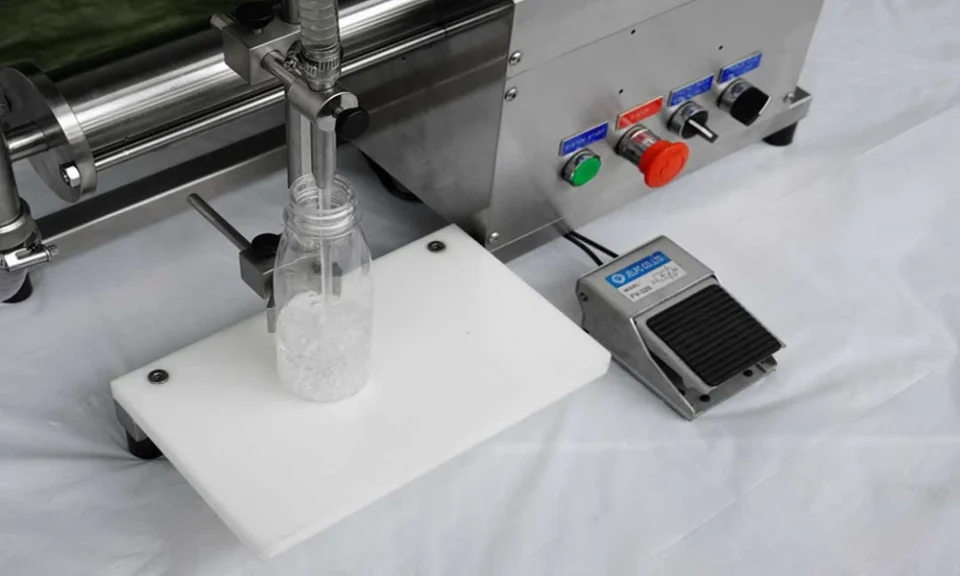
Liquid products cover an enormous range of physical behavior, from thin solvents that flow almost like water to viscous gels and pastes that barely move without mechanical assistance, and this range is exactly why there’s no single liquid filling machine that suits every application. A business shopping for an automatic liquid filling machine in Singapore needs to work through several technical and practical questions before comparing vendor quotes, since the right equipment depends heavily on product characteristics, container format, and how the line will run day to day rather than on general throughput claims alone.
Why Liquid Products Demand Different Filling Approaches
A filling machine tuned for water-thin liquids relies on principles that don’t translate well to viscous products, and the reverse holds equally true. Thin liquids flow readily under gravity or light pressure and can foam or splash if dispensed too quickly, which calls for nozzle designs that control flow rate near the end of the fill cycle. Viscous products resist flow entirely without mechanical assistance, so a machine handling them needs pumps or pistons capable of pushing thick material through a nozzle at a controlled rate. Products that fall in between, like many food sauces or personal care formulations, sometimes need a hybrid approach that switches dosing behavior partway through the fill cycle to manage both flow characteristics and avoid excessive foaming or splashing.
Volumetric, Gravity, and Piston Filling Explained
Volumetric filling measures a fixed volume of product using a metering chamber or flow meter, delivering consistent fill volumes regardless of minor density variation, which suits products with stable viscosity run after run. Gravity filling relies on head pressure from an elevated product tank to push liquid into containers, offering a simpler and often lower-cost mechanism that works well for thin, free-flowing liquids but struggles with anything more viscous. Piston filling uses a mechanical piston to displace a precise volume of product into the container, handling thicker liquids and pastes far more reliably than gravity systems because the piston physically pushes material through rather than relying on flow under its own weight. Selecting between these methods comes down to matching the mechanism to the product’s actual flow behavior rather than choosing based on cost alone.
Matching Machine Specifications to Product Viscosity
Viscosity should be measured and specified in concrete terms before approaching a supplier, since descriptions like thick or runny mean different things to different people and won’t help an engineer size pumps, nozzles, or piston bores correctly. Products near the higher end of the viscosity range, such as pastes or gels, often require heated hoppers or product lines to keep viscosity workable, since some formulations thicken further at room temperature in a way that slows filling and risks inconsistent dosing. A supplier who asks detailed questions about viscosity, temperature sensitivity, and settling behavior during the specification stage is generally better positioned to recommend suitable equipment than one who quotes based on container size and desired speed alone.
Container Handling and Changeover Speed
Beyond the product itself, container format drives significant design decisions in a liquid filling machine, since bottles, jars, pouches, and pails all require different infeed mechanisms, nozzle heights, and container stabilization during the fill cycle. Businesses running multiple container sizes through the same line need to weigh how quickly a machine can switch between formats, since a changeover that takes hours to reconfigure erodes much of the efficiency gained from automation in the first place. Comparing automatic liquid filling machines built for the range of containers common in local production against a plant’s actual product mix, rather than against a single flagship container format, gives a more realistic picture of how the equipment will perform across a full production schedule.
Cleaning and Product Changeover in Multi-Product Lines
Plants that run several different liquid products through the same filling line need equipment that can be cleaned thoroughly and efficiently between runs, since residual product left in hoses, valves, or nozzles can contaminate the next batch or, in food and cosmetic applications, create a compliance problem. Machines designed with clean-in-place capability or easily disassembled product-contact parts reduce the labor and downtime associated with changeover, which matters considerably on lines running multiple SKUs in a single shift. Evaluating how a machine handles cleaning should happen during the selection process rather than being treated as an afterthought, since retrofitting better cleaning access onto an already-installed machine is far more difficult than specifying it upfront.
Evaluating Total Cost Beyond the Machine Price
The purchase price of a filling machine represents only part of its total cost over the equipment’s operating life, since energy consumption, wear part replacement, changeover labor, and downtime during maintenance all add up over years of production. A cheaper machine that requires more frequent nozzle replacement or runs slower on viscous products can end up costing more over time than a higher-priced system built specifically for the product range in question. Businesses comparing quotes should ask suppliers for realistic maintenance schedules and wear part costs alongside the headline price, since this comparison usually reveals a clearer picture of long-term value than the initial quote alone.
Choosing the right automatic liquid filling machine comes down to a methodical match between product characteristics, container format, and production schedule rather than a search for the fastest or cheapest option on the market. Singapore manufacturers benefit from treating this as an engineering decision first and a procurement decision second, working through viscosity, changeover frequency, and cleaning requirements before comparing vendor proposals, since a machine well matched to the actual product being filled will outperform a faster-rated machine that struggles with that product’s specific flow behavior.
