
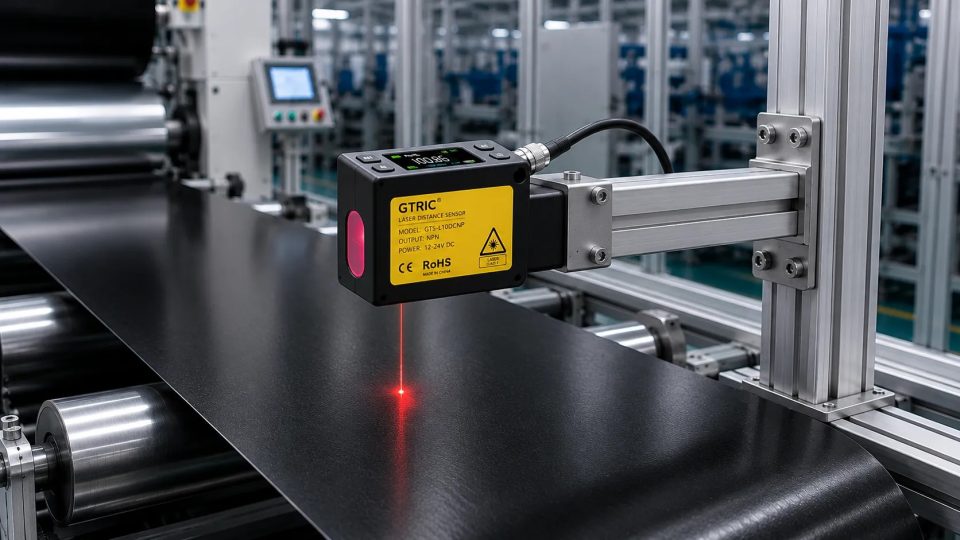
Automated inspection starts with a practical question: what must the production line measure, and what decision will follow? A missing component, an incorrect assembly height and a changing surface profile require different inspection arrangements. Before comparing sensor catalogues, define the target, the permitted variation and the action the controller should take when a reading falls outside the accepted limits.
Define the measurement before choosing the hardware
A laser displacement sensor measures changes in the position of a target surface without physical contact. In a triangulation arrangement, reflected light reaches a receiver, and changes in the received spot position are used to calculate displacement. This can support height, step or position checks, provided the target and installation suit the selected sensor. Thickness measurement also requires a defined reference or an appropriate multi-sensor arrangement; one distance reading does not automatically establish thickness.
Check the complete measuring window
The nominal reference distance is not necessarily the full usable measuring range. Record the nearest and farthest target positions, including part variation, fixture movement and installation tolerance. Compare that complete interval with the model’s documented measuring window. Also check whether the optical spot fits the surface being inspected and whether nearby edges or fixtures could obstruct the light path. Choosing a longer distance alone does not resolve these installation questions.
Separate resolution from production acceptance
Resolution, repeatability and accuracy describe different aspects of measurement performance. A fine resolution figure should not be treated as proof that a complete production setup can meet the same tolerance. Ask which target, temperature and operating mode were used for the published specifications. Where acceptance depends on repeatability or overall uncertainty, request relevant evidence and evaluate the assembled system instead of relying on a single catalogue number.
Test the real material and operating speed
Surface colour, gloss, angle and ambient light can affect optical measurement. A successful test on one reference target does not establish suitability for every metal, coating or plastic. Test representative samples, including the variations expected during production. Include mounting stability and the working environment in the trial. Check response and averaging settings against actual target movement, because a smooth-looking display is not, by itself, evidence that brief changes are being captured.
Match the signal to the controller
Confirm the receiving controller’s input requirements before ordering. Current, voltage and digital communication versions may need different wiring and configuration. For an RS485 version, obtain the communication protocol and register documentation rather than assuming compatibility from the interface name alone. The quotation should identify the complete model code, power requirements, cable arrangement and any accessories needed for the proposed installation.
Turn the selection into a documented trial
For a practical comparison, the DAIDISIKE DDK-G series product page brings together model-specific measuring windows, output options, technical documents and quotation information. Use those details to prepare a shortlist, then send the supplier the target material, movement interval, required tolerance, operating speed and controller interface. Confirm any unpublished performance or communication details before approval.
Record the trial settings, acceptance method and unresolved questions. A useful purchasing decision is not simply the sensor with the most impressive headline specification, but the documented configuration that has been evaluated for the intended inspection task.
